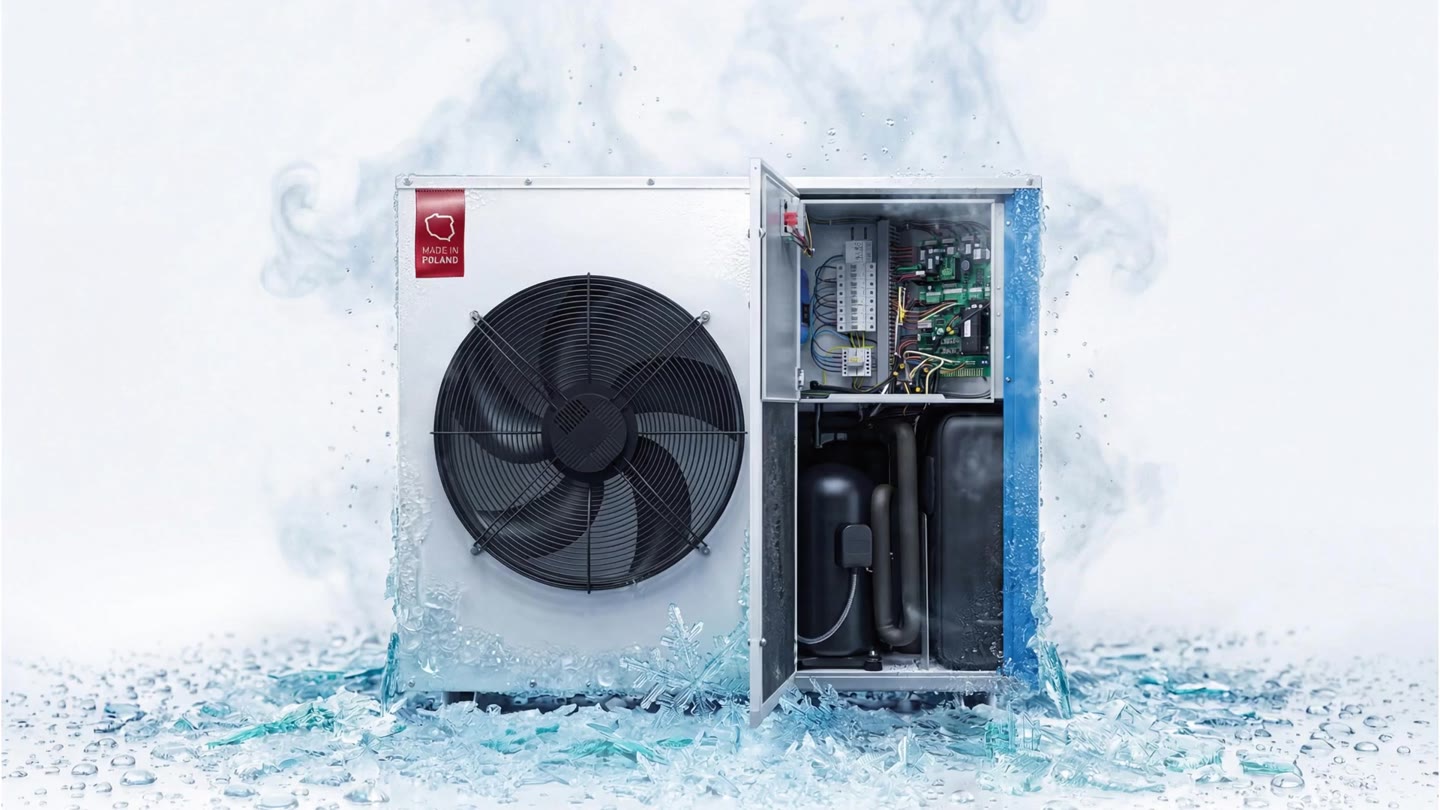
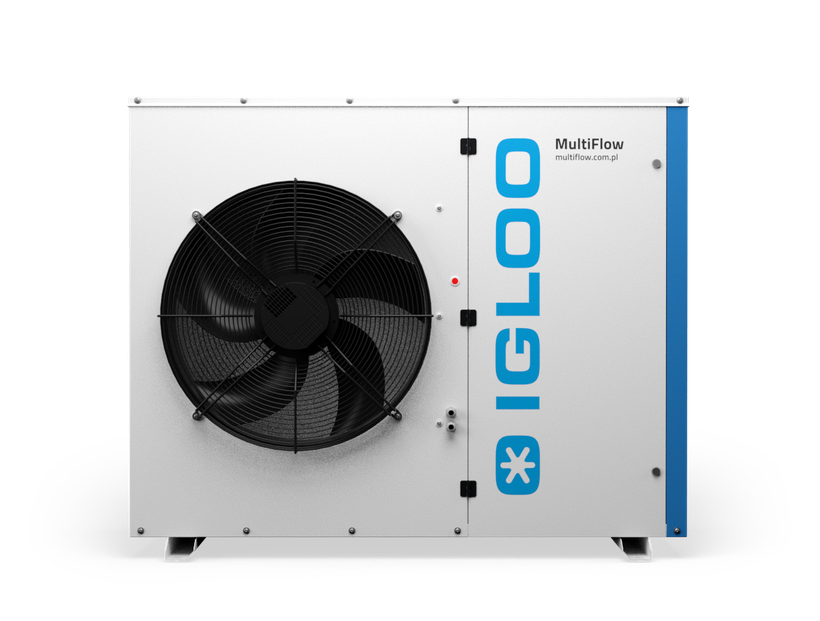
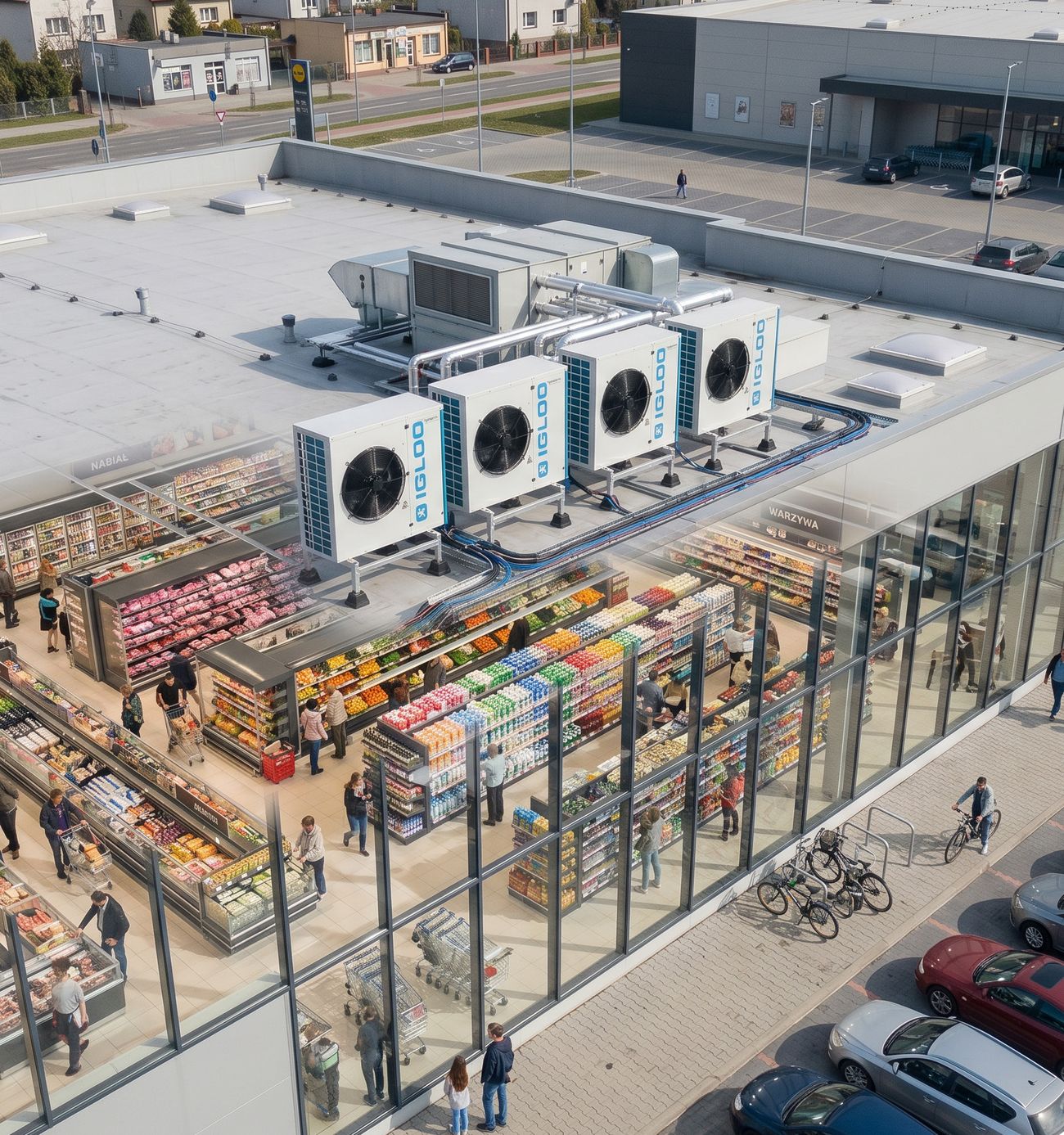
An inverter glycol water chiller that steplessly matches cooling capacity to real-time demand. It runs on the natural R290 refrigerant, uses less energy thanks to its PLC controller and works quietly — regardless of outdoor conditions. The whole circuit is factory-sealed, and the savings come from the very design of the glycol system.
Made in PolandTÜV RheinlandMagnelis housing · 25 years
Stepless control
Cooling capacity matched to real-time demand
1.9kWminimum
11.5kWmaximum
Electrical power input 0.75–5.94 kWA35/W-3
Mitsubishiscroll compressor, inverter
R290natural refrigerant · GWP 3
35 dB(A)silent night mode
Key features
Everything that matters — in one unit
Natural refrigerant, stepless capacity control and a factory-sealed design. The key MultiFlow specs at a glance.
R290 refrigerantnatural · GWP 3 · ODP 0
Mitsubishi compressorscroll · inverter technology
Plug & play monoblockfactory-charged and sealed
Cooling capacity range1.9–11.5kWstepless control · input 0.75–5.94 kW
Noise level · silent mode35dB(A)quiet operation at night
Housing warranty25yrsMagnelis steel
Lower energy use−50%vs freon systems
Where MultiFlow works
Precise cooling where efficiency matters
Capacity from 1.9 to 11.5 kW covers both a single location and a large cascade installation. MultiFlow chillers prove themselves in retail, foodservice, industry and laboratories.
Storesgrocery & delicatessen
Restaurants& foodservice
Laboratoriesprocess cooling
Patisseries& bakeries
Savings built into the technology
A chiller that cuts costs on every front
The glycol system combines a natural refrigerant, a factory-sealed design and simple plumbing installation. Savings aren’t an add-on — they come from the very design of the system.
Energy use
MultiFlow vs a traditional freon system (baseline)
Traditional freon system100%
IGLOO MultiFlowup to −50%
Working fluid cost
Propylene glycol vs freon — refill cost
Freon (HFC refrigerant)~€64/kg
Propylene glycol~€1.2/l
up to 50%
lower energy use than traditional freon systems
~€240
saved per unit each year — no mandatory leak inspections
€0
paperwork and CRO fees — you are not an F-gas operator
4.5×
better energy efficiency than a CO₂ system — at the same eco class
Glycol vs freon
An indirect system changes the economics of store refrigeration
The key differences between the MultiFlow glycol system and a classic freon (HFC) installation — from paperwork and running costs to installation.
Criterion
IGLOO MultiFlow (glycol)
Freon system (HFC)
F-gas operator registration (CRO)
Not required
Required — you become an F-gas operator
Periodic leak inspections
None — hermetic circuit
Min. 1/year · ~€240
Receiving-side installation
Ordinary plumber — no F-gas licence
Refrigeration installer with F-gas licence
Working fluid and its cost
Propylene glycol · ~€1.2/l
HFC freon · ~€64/kg
Refrigerant in the chiller
R290 (propane) · GWP 3 · ODP 0
HFC refrigerant · high GWP
Pressure in the receiving network
~10× lower — lower leak risk
High refrigerant pressure
Charging and circuit tightness
Factory — plug & play monoblock
Done on site by the installer
Behaviour on failure / leak
Keeps running — long lag time
Immediate shutdown — refrigerant escapes at once
Energy use
up to 50% lower
Baseline (100%)
Expansion valve in the cabinets
Not needed — electronic valve in the chiller
Required in every cabinet
Capacity scaling
Cascade up to 32 units (~370 kW)
Separate freon installations
Comparison data refers to the MultiFlow glycol system versus a typical HFC freon installation. Cost figures are indicative and depend on configuration and market. Prices are converted at 4.2 PLN/€.
Why a glycol system
Eight reasons it pays off
No CRO registration
You are not an F-gas operator. Zero registration paperwork.
No leak inspections
The refrigeration circuit is hermetic. Saves ~€240 per unit each year.
Installation without an F-gas licence
An ordinary plumber does the work. Easy access to contractors, no F-gas certificates.
Natural fluids — R290 and glycol
R290 (propane): GWP 3, ODP 0. Propylene glycol used in the food and pharmaceutical industries.
10× lower working pressure
Glycol circulates at a fraction of freon’s pressure. Lower leak risk.
Plug & play — monoblock
The chiller ships factory-charged and sealed. No gradients, traps or anti-traps.
Fluid at a fraction of the price
Glycol at €1.2/l instead of freon at €64/kg. The manufacturer handles charging and tightness.
Cascade up to 32 units
~370 kW of capacity in one hydraulic system, linked over Ethernet with no master controllers.
Key technical features
Industrial engineering in a compact housing
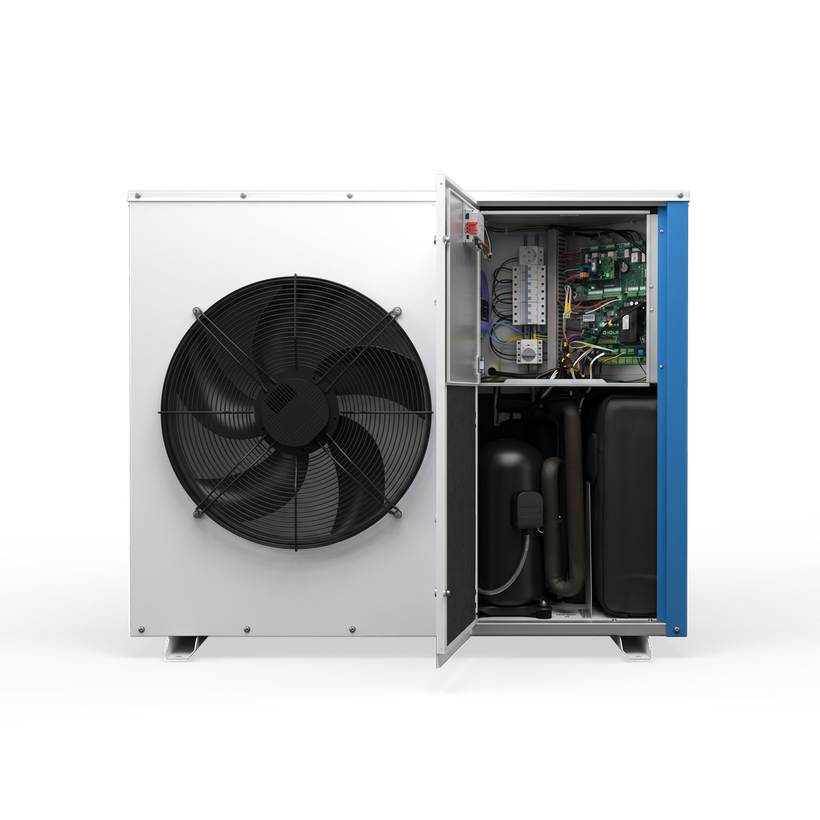
Beneath the Magnelis steel housing sit a Mitsubishi scroll compressor, a Carel PLC controller and an extensive protection system — all so the chiller runs quietly, efficiently and reliably for years.
Inverter technologyStepless control of the Mitsubishi scroll compressor.
Silent Night ModeNoise reduced to 35 dB(A) at night.
LTE/GSM monitoringRemote supervision without internet, LAN or Wi-Fi.
Cascade ReadyLink units over Ethernet.
Carel PLC controllerSchedules, data logging, BMS/Modbus.
Protection systemDanfoss pressure switches, MBS 3000, Nuova valves.
One system, zero losses
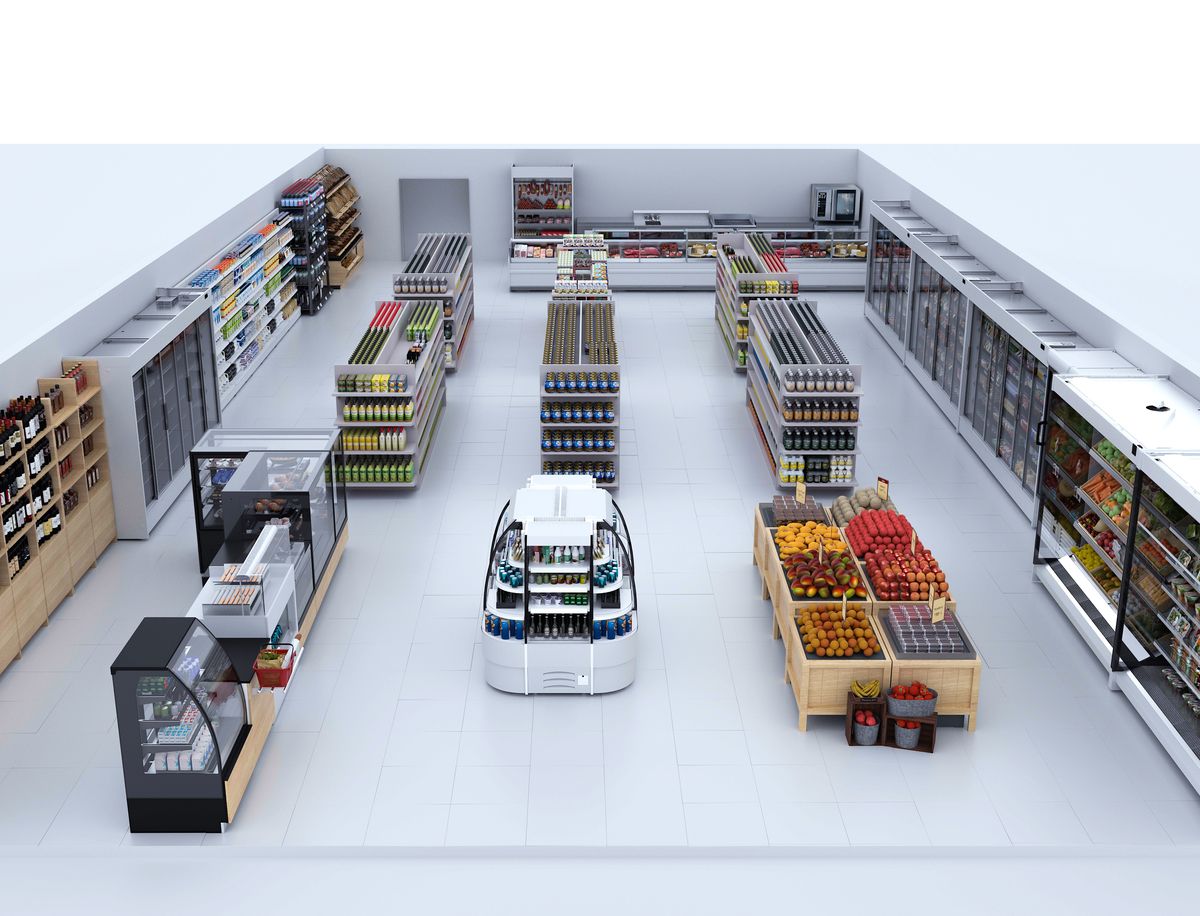
MultiFlow works with IGLOO Glycol-Ready cabinets
Refrigerated cabinets designed for the glycol system form one integrated ecosystem with the chiller. They run at a temperature difference of just 2–3 °C and minimal flow resistance — with an immediate effect on goods and costs.
Reduced product dehydration by up to 60% — meat, dairy and vegetables keep their weight and quality
Stable, gentle temperature and less glass misting
Fewer losses and markdowns, more products at full value
From a single location to a large installation — without separate freon systems
In a cascade you link up to 32 units in one coherent hydraulic system controlled over Ethernet. Expanding the site doesn’t require redesigning the refrigeration installation.
32units
maximum cascade
~370kW
total cooling capacity
2.5×
cheaper to install than CO₂
Technical specs
IGLOO MultiFlow glycol water chiller
Max. cooling capacity (A35/W-3)11.5 kW
Min. cooling capacity (A35/W-3)1.9 kW
Max. electrical power input (A35/W-3)5.94 kW
Min. electrical power input (A35/W-3)0.75 kW
CompressorMitsubishi (scroll, inverter)
RefrigerantR290
Power supply400 V / 3-phase / 50 Hz
Medium connection (inlet/outlet)GZ 5/4
Max. noise level40 dB(A)
Noise level — silent mode35 dB(A)
Dimensions (L×W×H)1390 × 590 × 1135 mm
Weight240 kg
Cascadeup to 32 units (~370 kW)
Housing warranty (Magnelis)25 years
Ask about a MultiFlow configuration for your site
We’ll size the chiller and a set of Glycol-Ready cabinets for your store, venue or process installation. We’ll get back to you with a proposal and a quote.
Fill in the form — we’ll come back with a proposal within 1 business day.
By clicking “Send”, you agree to be contacted about a MultiFlow quote.
Thank you!Your enquiry has been received. We’ll be in touch soon.
FAQ — savings and cooling costs
Frequently asked questions about saving in your store
Concrete answers for owners of stores, foodservice venues and process installations looking to lower their energy and refrigeration service costs. The first questions summarise the key information on this page.
How much does MultiFlow save a store owner?
Savings come from four sources at once: up to 50% lower energy use than freon systems, no mandatory leak inspections and zero CRO fees, a far cheaper working fluid (glycol approx. €1.2/l vs freon ~€64/kg) and lower product losses — Glycol-Ready cabinets reduce dehydration, so meat, dairy and vegetables keep their weight and quality longer (fewer markdowns and write-offs). IGLOO estimates the exact figure for the number and type of units in a given store.
What is IGLOO MultiFlow and how does it work?
MultiFlow is a glycol water chiller working in an indirect (glycol) system. The natural R290 refrigerant stays factory-sealed inside the chiller monoblock, while only safe propylene glycol circulates around the store, cooling cabinets and display cases. The inverter compressor steplessly adjusts capacity across 1.9–11.5 kW, matching it to real-time demand.
How does the MultiFlow glycol system differ from a classic freon installation?
Key differences: no CRO registration and no mandatory leak inspections, installation by an ordinary plumber without an F-gas licence, factory tightness (plug & play), ~10× lower working pressure and lower leak risk, the natural R290 (GWP 3, ODP 0) refrigerant instead of freon, and a cheaper working fluid. On top of that, up to 50% lower energy use.
Which businesses is MultiFlow suited to?
For grocery stores and delicatessens, restaurants and foodservice, patisseries and bakeries, and laboratories and process cooling. One chiller feeds cabinets, display cases and counters from a single system, and for larger sites units are linked into a cascade.
What are IGLOO Glycol-Ready cabinets and what do they offer?
They are refrigerated cabinets designed specifically for the glycol system. Together with the MultiFlow chiller they form one integrated ecosystem that runs at a temperature difference of just 2–3 °C and minimal flow resistance. The result is a stable, gentle temperature in the cabinets and less product dehydration — fewer losses and markdowns.
How does MultiFlow scale as a store expands?
For a single location one chiller with a stepless 1.9–11.5 kW capacity is enough. As you expand, units are linked into a cascade of up to 32 (~370 kW) over Ethernet, with no master controllers — capacity grows with your needs, without building separate installations.
What are the key specs, controls and safety features of MultiFlow?
Cooling capacity 1.9–11.5 kW (electrical power input 0.75–5.94 kW), R290 (GWP 3, ODP 0) refrigerant, a Mitsubishi inverter scroll compressor, a Carel PLC controller and LTE/GSM monitoring (supervision without an internet connection). An adaptive algorithm cuts noise to 35 dB(A) at night. The circuit is protected by, among others, a thermal cut-out, discharge- and overheat-temperature sensors and safety valves. The Magnelis steel housing carries a 25-year warranty.
How can I lower cooling energy costs in a grocery store?
The biggest saving comes from switching from a freon system to an indirect (glycol) system with an inverter compressor that steplessly matches capacity to demand rather than cycling on and off. The IGLOO MultiFlow chiller uses up to 50% less energy than traditional freon systems, and the controller’s adaptive algorithm further reduces consumption and cuts noise to 35 dB(A) at night.
Which is more energy-efficient — a freon installation or a glycol system with an inverter?
In typical store operation, an indirect glycol system with an inverter compressor (as in IGLOO MultiFlow) is more efficient. Capacity is steplessly controlled across 1.9–11.5 kW, and combined with IGLOO Glycol-Ready cabinets the system runs at a temperature difference of just 2–3 °C. The result is up to 50% lower energy use than classic freon systems.
How can I lower the operating and service costs of a freon installation?
The biggest costs of a freon installation are mandatory periodic leak inspections, CRO registration fees and F-gas certified service. The IGLOO MultiFlow glycol system removes these: no mandatory leak inspections, zero CRO fees, and the receiving-side installation is done by an ordinary plumber — without F-gas certificates. The working fluid (propylene glycol) costs approx. €1.2/l versus ~€64/kg for freon.
How much can I save by switching from freon to a glycol system?
Savings come from three sources: up to 50% lower energy use, no mandatory leak inspections and no CRO fees, and a far cheaper working fluid (glycol approx. €1.2/l vs freon ~€64/kg). The scale depends on the number and type of units — IGLOO sizes the configuration and estimates the payback for your specific store.
Is an R290 (propane) chiller safe and compliant?
Yes. R290 (propane) is a natural refrigerant with GWP = 3 and ODP = 0 — outside F-gas regulation restrictions and compliant with ecodesign standards. In MultiFlow the refrigerant stays factory-sealed inside the chiller monoblock, while only safe propylene glycol — widely used in the food industry — circulates in the store space.
Which glycol water chiller should I choose for a small store or venue?
For a single store, bakery, patisserie or restaurant, one IGLOO MultiFlow chiller with a stepless 1.9–11.5 kW capacity is enough, feeding cabinets, display cases and counters from one system. As you expand, units are linked into a cascade of up to 32 (~370 kW) over Ethernet, with no master controllers.
Does the installation require an F-gas certified technician?
No. The receiving-side (glycol) installation in the store is done by an ordinary plumber — without an F-gas licence or expensive specialists. The chiller ships factory-charged and sealed (plug & play monoblock), so the installer never touches the refrigerant circuit.
Need a quote for your store? Request a quote — we’ll size the capacity and configuration and estimate the savings.